Coming soon, July of 2026!
Tired of getting bills? Send and receive something that actually makes your day. Join the Postcard Club!
The Analog Revolution: Why Two Scrawled Lines Beat Two Hundred Digital Texts
The Modern Mailbox Fatigue
We have all felt that specific, hollow disappointment: the clatter of the mailbox lid followed by the retrieval of nothing but glossy flyers, demanding invoices, and predatory credit card offers. In our rush toward the future, the mailbox has been relegated to a repository for the mundane. Our world is “too fast and too digital,” and in this high-speed slipstream, genuine connection often feels like an exhausting chore—another notification to clear, another “unread” bubble to pop.
The “Postcards by Snail Mail” philosophy is a curated rebellion against this digital noise. It is an invitation to embrace the “small pause.” By reclaiming the physical mailbox for something other than a bill, we transform a routine errand into a tactile ritual of surprise. It is a slow, intentional movement that proves a handheld hello can provide an analog sanctuary in a frantic month.
The Power of the “No-Pressure” Hello
The greatest barrier to connection is the myth that it must be a “big production.” We tell ourselves we’ll write that letter when we have an hour of peace or when we’ve composed an essay worthy of the recipient. But the most sustainable habit is the one with the lowest friction. A postcard demands no poetry. It thrives on the “quick line,” the spontaneous doodle, or even just a scrawled “Thinking of you” followed by a signature.
By stripping away the expectation of length, the act of reaching out becomes a five-minute joy rather than a daunting task. This is the art of the “no-pressure” hello—a small effort with an outsized emotional return.
“Seriously: five minutes, one stamp, and you’ve done more than a text ever will.”
A Multi-Sensory Experience: Mail You Can Hear
While the medium is paper, the experience is modern and multi-sensory. Each month’s curated drop includes a way to “set the tempo” for your writing. By scanning a QR code on the back of the card, you unlock a soundtrack—on Spotify or YouTube—specifically selected to keep you company. Whether it’s a “slow” track for a reflective note or a “quick” track for a fun greeting, the music helps overcome “blank page syndrome.”
This isn’t just a card; it’s a curated care package. Each delivery is enriched with “small extras”—cool stickers, cardboard coasters, or vintage patches—meant to be used or swapped. These tactile treasures, combined with a monthly prompt like “A memory that still makes you laugh,” transform a simple piece of mail into a moment of intentional enrichment.
The Secret History of the “Divided Back”
To appreciate the postcard is to understand its rebellious history. In the late 1800s, cards were strictly regulated by size and color. It actually took an Act of Congress in 1861 to allow private cards to enter the mail stream. Even then, the government guarded its monopoly; only official cards could bear the term “Postal Card” and were mailed for a penny, while private versions cost double.
For decades, the back of the card was reserved strictly for the address. If you wanted to write a message, you had to squeeze it onto the margins of the image on the front. This changed in 1907 when the Universal Postal Congress decreed the birth of the “Divided Back”—message on the left, address on the right. This sparked the “Golden Age of Postcards.” However, this era faced a tragic decline during World War I; American printing lacked the sophisticated technology of German printers, and as quality fell, so did the public’s fervor. Today, we are not just sending mail; we are resurrecting a lost art form of high-quality, intentional deltiology.
Guerrilla Kindness and the Library Bookmark
The “Postcards by Snail Mail” mission is built on four pillars: Joy, Connection, and Enrichment. There is no better way to fulfill these than through “guerrilla” postcard placement—leaving anonymous smiles for strangers to find.
- The Library Tactic: Tuck a written card into a library book as a surprise bookmark for the next reader.
- The Neighborly Nudge: Leave a card on a grocery store shelf or a park bench.
- The Expert Tip: When leaving “guerrilla” mail, place an art sticker where the stamp would usually go. This signals to the finder that the card is a gift meant for them, not a lost piece of mail.
These acts provide Relief from the digital grind and Enrichment through the simple, selfless act of anonymous kindness.
Conclusion: Reclaiming the Slow Pace
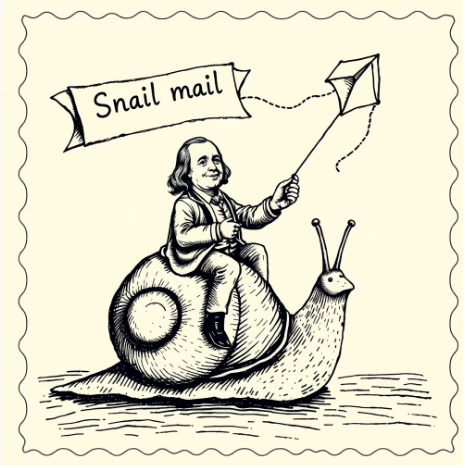
Snail mail is a celebration of the wait. Unlike the instant, often disposable nature of a text, a physical card carries the weight of anticipation. It’s the 3-8 days it takes to travel across the U.S. that delay is part of the magic. It is a “slow release” of joy.
By choosing to send a Handheld Hello, you are providing a tangible anchor in someone’s day. You are proving that they are worth more than a digital notification. You are providing a hello, art, and comfort—one stamp at a time.
If you could send a “Handheld Hello” to one person today to remind them they aren’t forgotten, whose name would be on the right side of the card?
 Turns out... I am Crazy!