I found a pair of the Realistic Nova 18 Speakers at the White Elephant over the holiday weekend and started the process of cleaning and fixing up the 1993 built speakers.
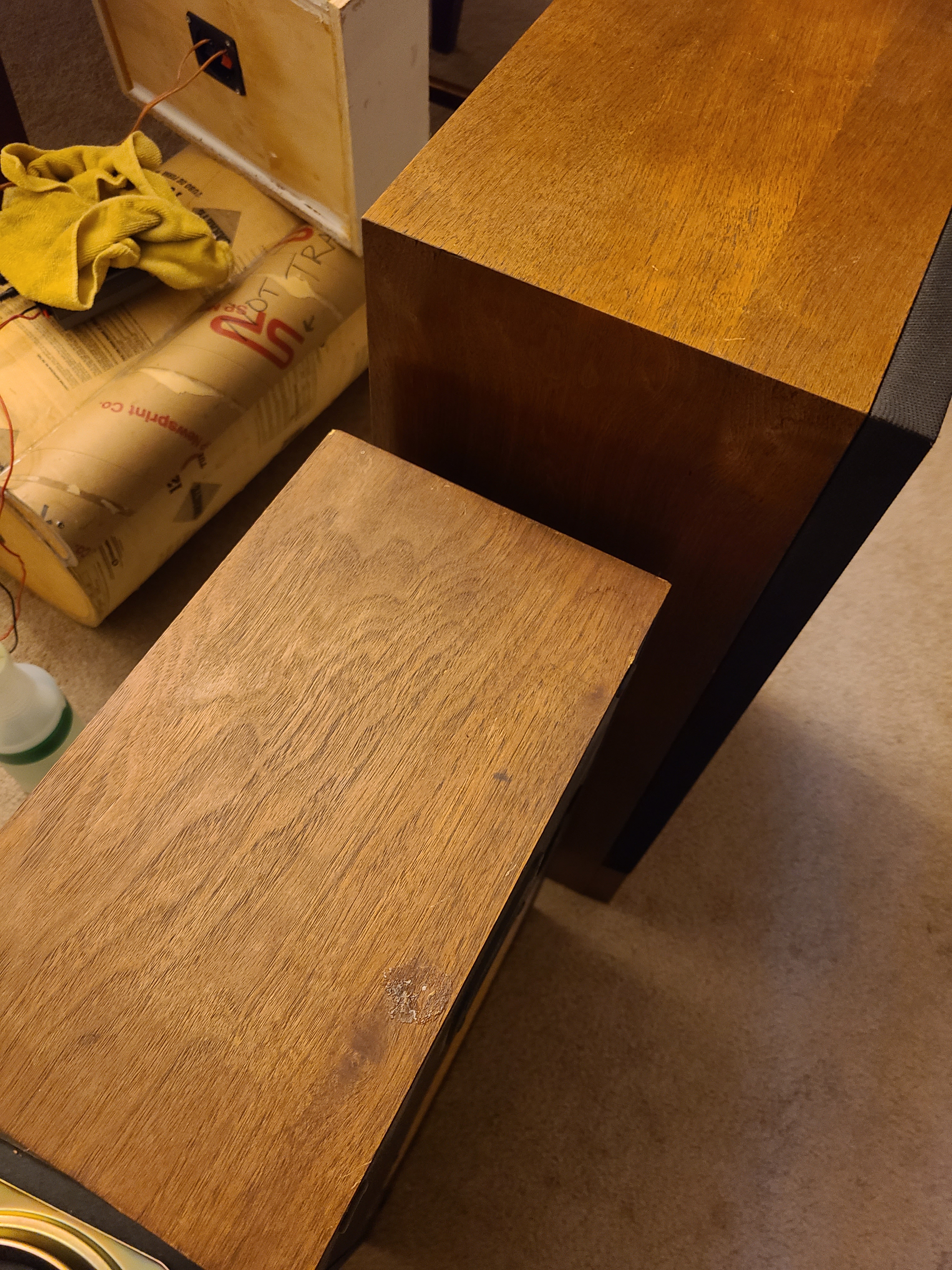
Using similar stain, I cleaned the walnut vener with a cloth and lightly sanded them. I used wood glue on the back bottom section that looks to be damaged from either water, or was dropped on the edge of one of the cabnets. Staining with two heavy coats and allowing them to dry, I went back over them with a quality wood wax/polish.
The woofers needed new foam surrounds and I went ahead and razored off the old breaking foam off the frame and paper woofer.


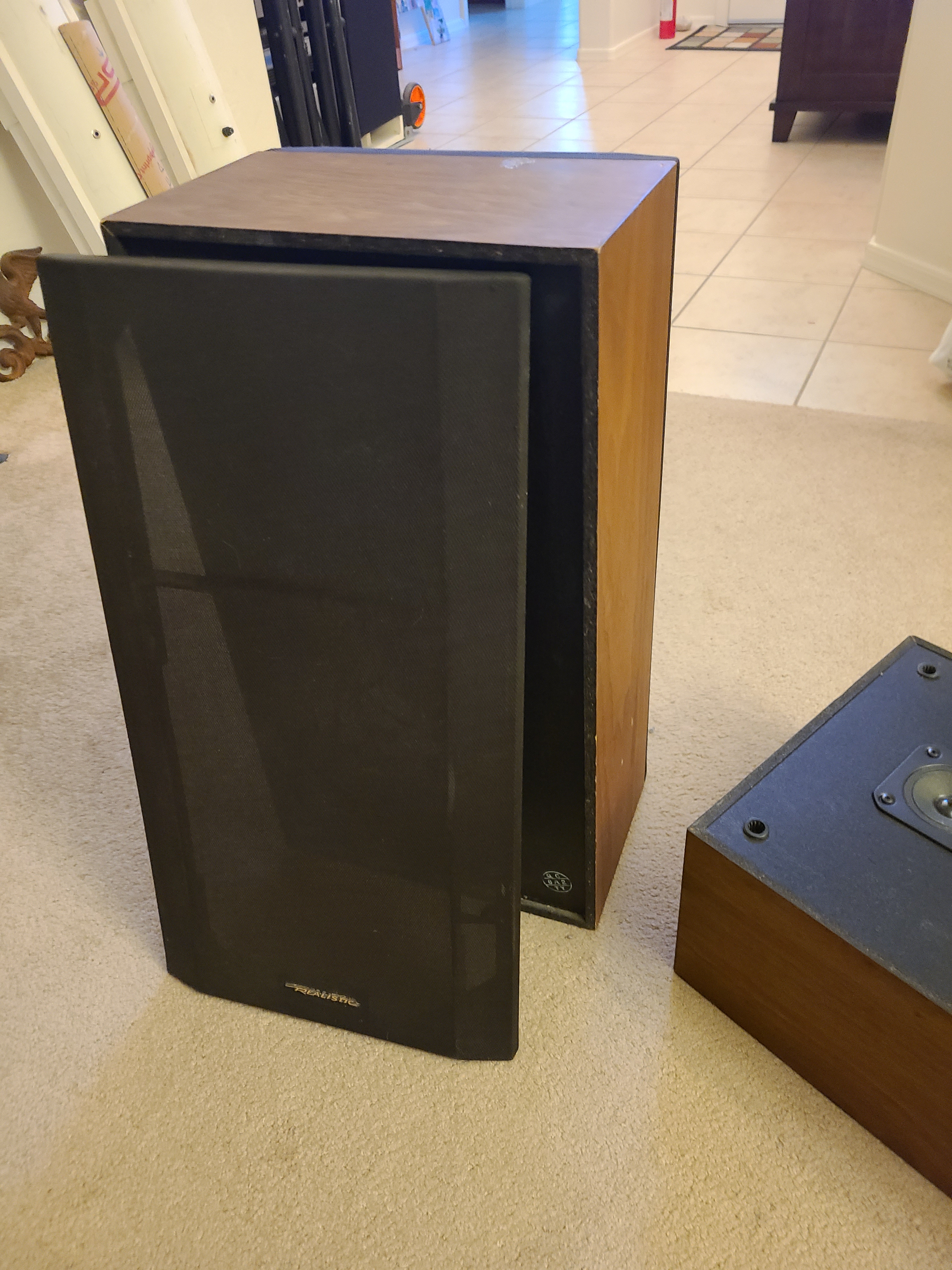

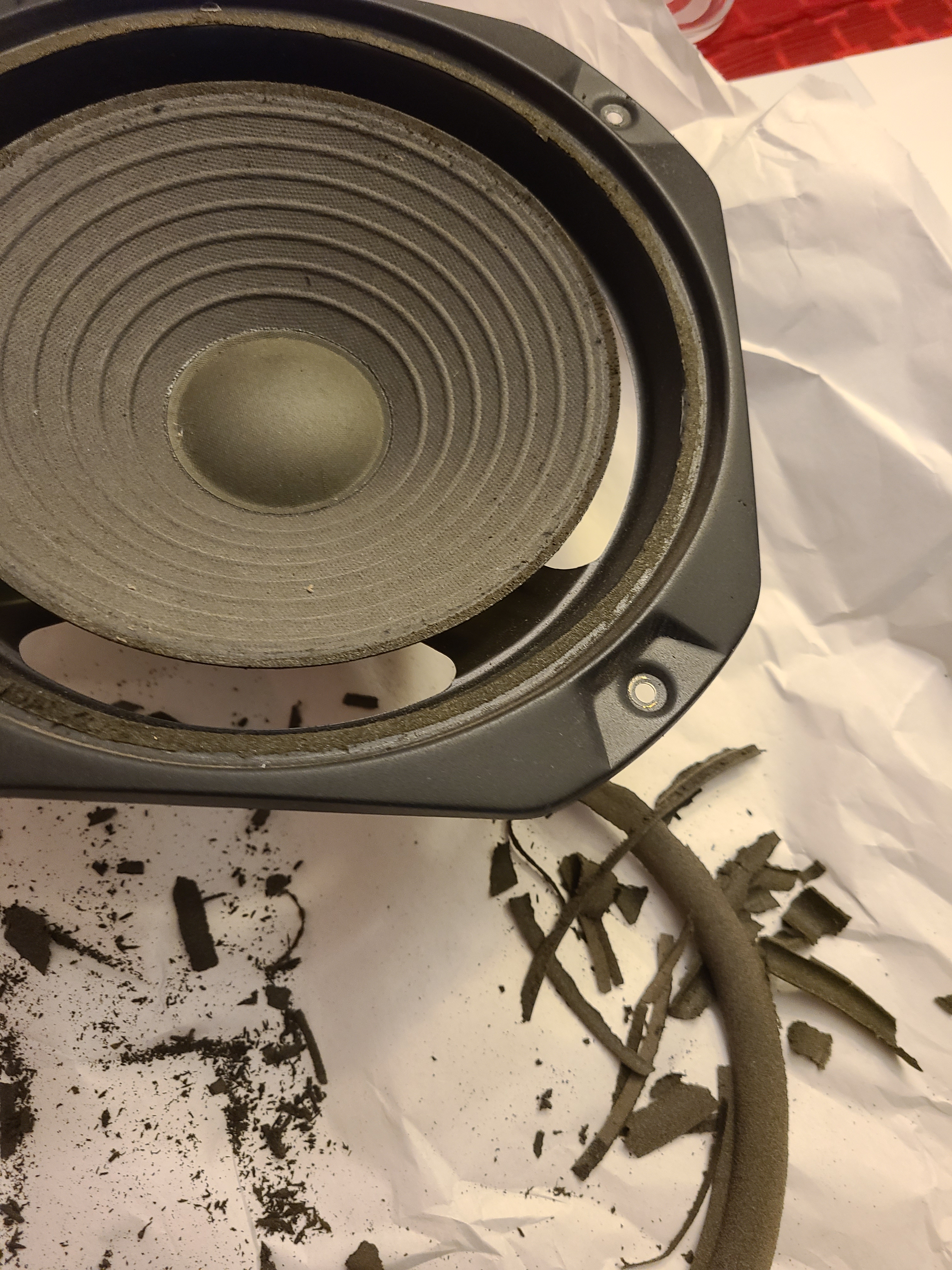

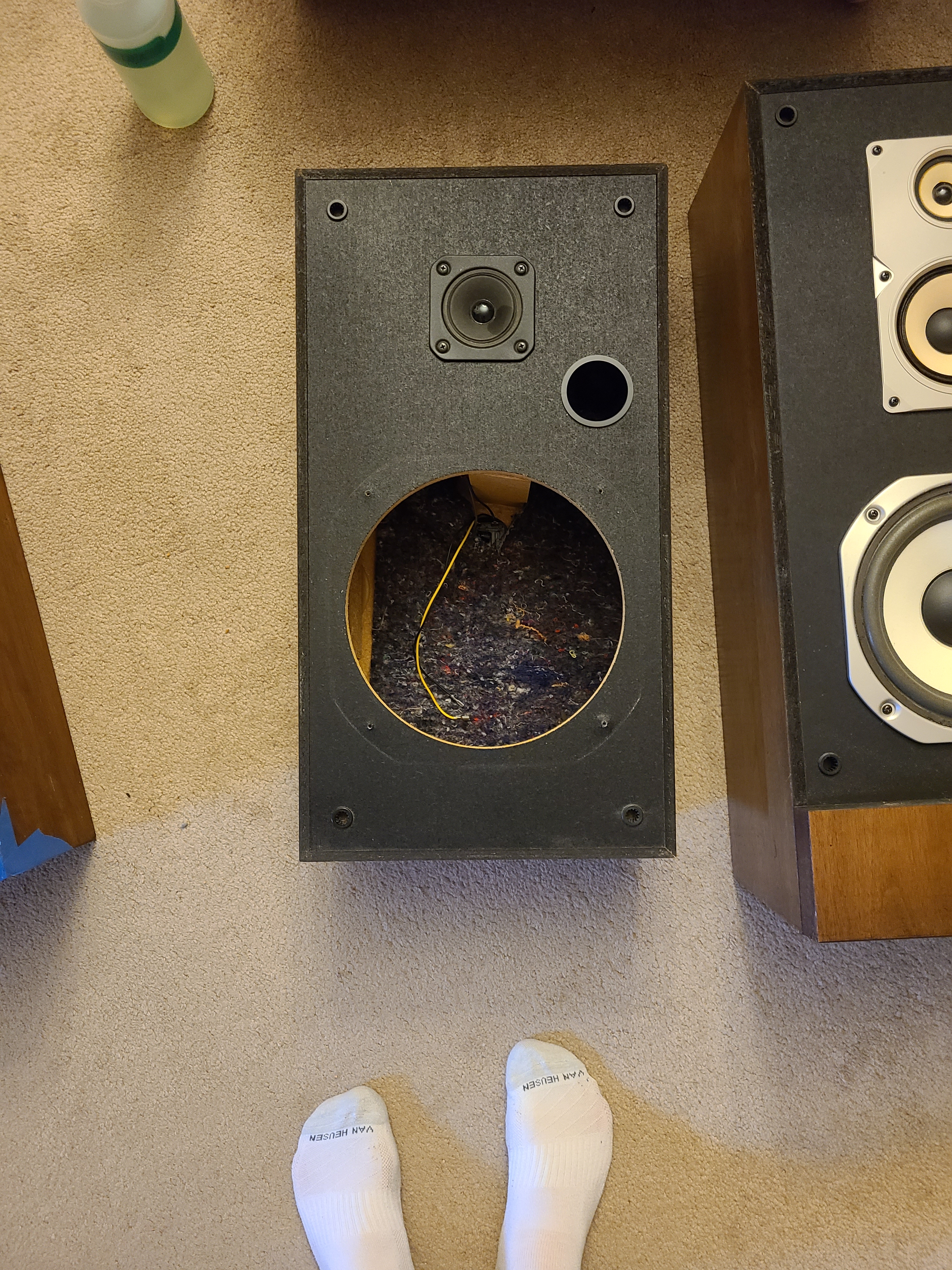


I replaced the foam on the woofers and used a company https://www.simplyspeakers.com/ to purchase the correct size foam speaker shrouds. I will not go into the details, as the website has an amazing instructional video library.


Here is pictures after the stain:

The table below is a comparison of the two speakers, funny how the larger woofer does not mean lower range in the frequency.
Also there is this “A more sensitive speaker is a more efficient one. Its like weight in a sports car – it makes everything better regardless of anything else. A lighter car will handle better no matter what. And similarly a more efficient speaker will be more dynamic and lively.
I see so many people raving about speakers like Polk/Elac which have terrible 86dB sensitivity, you need $$$ power amps to get decent volume out of them, and the heavy equipment makes people think they have an impressive system verses a speaker which is say 92dB which needs far less power. An efficient speaker is also a better design in most cases.”
One person wrote: “Radio Shack sold some pretty decent speakers (as well as some junk) but my recollection is that most of the Nova series was pretty decent. The foam surrounds on the woofers might need to be replaced if they’re beginning to crumble, it’s not expensive or particularly difficult to do. For $5 I personally would definitely grab them.” I bought these for 10 Bucks. (mind you the foam surrounds cost me 30.00 Bucks). It’s not hard but they are in need of a bit of care. You need to remove the old foam with a razor blade and glue in new surround and you have to get it perfectly centered. To do this I use a frequency generator (CFG250 Teketronik… see below) and get that woofer moving while you glue it up(45 Hz, not loud, but just so you can feel it)… nice and easy, not too loud. But the coil will center and the glue will help make the speaker sit right. (look it up on youtube… you will figure it out if you want to do it!) After gluing it, turn off the signal and let it sit up right.
| Realistic-Optimus 600 Speakers | Realistic-Nova 18 Speakers |
| Description: 8″ WOOFER, 4″ Mid, 2 ” TWEETER Type: 3 way, 3 driver loudspeaker system Manufacture Year: 1986 ?? Frequency Response: 50Hz to 20kHz Power Handling: 100W Impedance: 8Ω Sensitivity: 90dB Bass: 1 x 300mm cone Midrange: 1 x 102mm cone Tweeter: 1 x 64mm cone Enclosure: tuned port Grille: removable Dimensions: 28 x 14 x 10.75 inches Weight: 15kg Price: USD $149.95 (1987) | Description: 10″ WOOFER, 3″ TWEETER Type: 2 way, 2 driver loudspeaker system Manufacture Years: 1990 – 1997 Frequency Response: 60Hz to 20kHz Power Handling: 100W Impedance: 8Ω Sensitivity: (as of right now, I have never found a dB rated) dB Bass: 1 x 495 mm cone Tweeter: 1 x 76 mm cone Enclosure: tuned port Grille: removable Dimensions: 22 x 12 x 8 inches Weight: kg Price: USD $100.00 (1993) |
Side note on the Frequency Generator Tektronix CFG250…
Manufacturer Description:
The Tektronix CFG250 is a 0.2Hz to 2 MHz, Function Generator.

Performance Characteristics
- Form Factor Benchtop
- Number of Channels 1 ch
- Waveforms (Sine, Square, etc.) Sine,Square,Triangle
- Minimum Frequency .2 Hz
- Maximum Frequency, Sine wave 2 MHz
- Maximum Frequency, Square Wave 2 MHz
- Maximum Frequency, Triangle Wave 2 kHz
- Minimum Output Voltage 0 V
- Maximum Output Voltage 20 V
- Output Impedance 50 Ohm
- Sweep Modes External,Internal,Linear
Measurements/Features
- Variable duty cycle
- Var symmetry
Programmability/Connectivity
- User Interface Proprietary
Life Cycle Data
- Out of Production Nov-01-2000
Next come the tweeter specs:
New Old Stock (NOS). These are no longer in production. Available while supplies last.
This paper cone tweeter is a good replacement tweeter that fits many brands and models. Commonly used in McIntosh and more speakers. Also be used to replace the Peerless MT 20 HFC tweeter.
Notes from McIntosh:
– The 8 ohm and 16 ohm tweeters can be used interchangeably in the ML systems despite the difference in impedance. The measured acoustic response for either tweeter is identical from 7kHz to 20kHz using the same crossover. Electrically, the crossover is above 10kHz. These tweeters were used in the McIntosh ML-1C, ML-2C, ML-2M, ML-4C, ML-4M and ML-10C.
– An alnico magnet is glued to a U-shaped yoke that is welded to the front plate of the magnet structure. The cone/coil assembly is very lightweight and doesn’t even have a spider to center the voice coil. The cone is paper. The thin aluminum center dome weighs only 0.010 grams and radiates out to 20kHz. The positive terminal is indicated by a red insulating washer shown on the left side of the tweeter.
Specs:
Freq Range: 4500-20,000 Hz
Power Rating: 10 Watts
Impedance: 16 ohms
DCR: 15.3 ohms
Magnet: Alnico
Weight: 4.6 oz
Dimensions:
Outside Diameter: 2.25″ Square
Cutout Diameter: 2.125″
Mounting Depth: 1.31″


 Turns out... I am Crazy!